Preloader Close
Increase Energy Savings with Reflective Insulation Bubble Sheets

Send us Email
Blog Details
How Can Reflective Insulation Improve Indoor Sports Stadium Comfort?
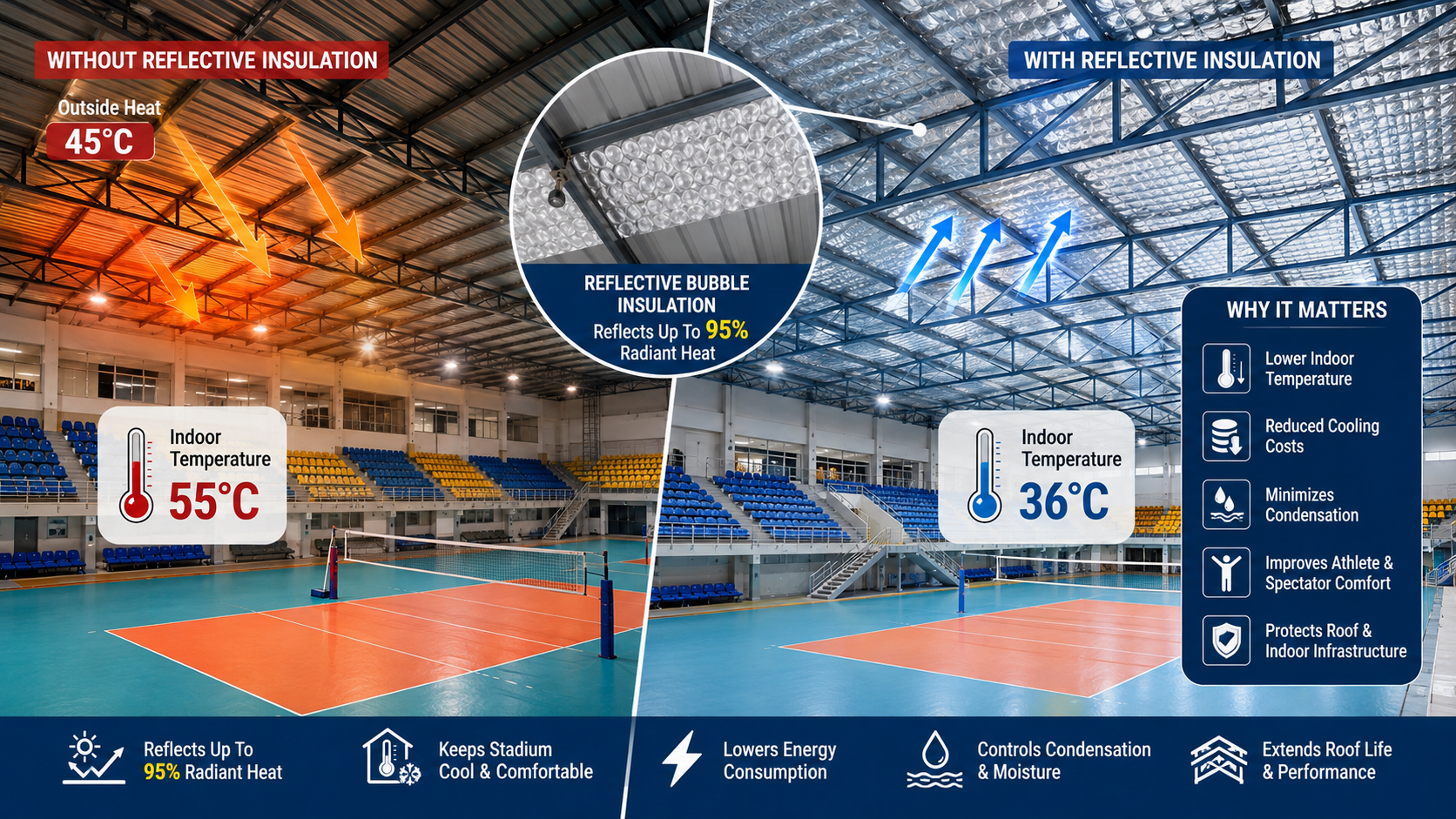
Indoor sports stadiums with metal roofs often become excessively hot because the roof absorbs solar radiation and transfers radiant heat into the playing area. Installing TIRI Reflective Insulation beneath the roof helps reflect up to 95% of radiant heat, creating a cooler indoor environment, improving athlete and spectator comfort, reducing HVAC energy consumption, and minimizing condensation.
Indoor Sports Stadiums Need More Than Just Air Conditioning
- Whether it's a badminton arena, basketball court, volleyball stadium, indoor tennis court, or multi-purpose sports complex, maintaining a comfortable indoor temperature is essential.
- Many stadium owners invest heavily in air conditioning systems but overlook one of the biggest sources of indoor heat—the roof.
- A large metal roof exposed to direct sunlight can reach extremely high surface temperatures. As the roof heats up, radiant heat is transferred into the building, making the entire playing area warmer.
- Instead of only increasing cooling capacity, reducing heat at the source is often a more efficient approach.
Why Do Indoor Sports Stadiums Become So Hot?
- Most indoor sports facilities use:
-
- o Pre-Engineered Building (PEB) structures
- o Steel roofing
- o Long-span metal roofs
- o High-ceiling industrial construction
- These roofs are durable and economical but are also excellent conductors of heat.
- During summer:
-
- o The metal roof absorbs intense solar radiation.
- o The roof temperature rises significantly.
- o Heat radiates downward toward the playing area.
- o Indoor temperatures increase.
- o Cooling systems work harder to maintain comfort.
- The larger the roof area, the greater the radiant heat entering the building.
How TIRI Reflective Insulation Works
- Unlike conventional insulation that primarily slows conductive heat transfer, TIRI Reflective Insulation is engineered to reduce radiant heat entering the building.
- It is installed beneath the metal roof, where its highly reflective aluminum surface helps reflect a significant portion of radiant heat away from the occupied space.
- Benefits include:
-
- o Reflects up to 95% radiant heat
- o Reduces roof heat transfer
- o Helps maintain more comfortable indoor temperatures
- o Supports HVAC efficiency
- o Helps control roof condensation
- o Requires minimal maintenance after installation
Benefits of Reflective Insulation for Indoor Sports Stadiums
- 1. Improves Athlete Comfort
- Athletes perform best in comfortable indoor conditions. Reducing excessive roof heat can help create a more pleasant environment for:
-
- o Basketball
- o Volleyball
- o Badminton
- o Indoor football
- o Table tennis
- o Gymnastics
- o Martial arts
- o Multi-sport events
- Lower indoor temperatures can also reduce heat stress during training and competitions.
- 2. Enhances Spectator Experience
- A cooler indoor environment contributes to:
-
- o Greater seating comfort
- o Better event experience
- o Improved visitor satisfaction
- o Increased likelihood of repeat attendance
- 3. Reduces Cooling Costs
- Air conditioners cannot stop heat from entering through the roof—they only remove heat after it has entered the building. By reducing roof heat gain, TIRI Reflective Insulation lowers the cooling load, allowing HVAC systems to operate more efficiently and potentially reducing electricity costs.
- 4. Helps Control Roof Condensation
- Indoor stadiums frequently experience humidity from large crowds and sports activities. Reflective insulation helps reduce condensation, protecting:
-
- o Sports flooring
- o Lighting fixtures
- o Steel structures
- o Electrical systems
- o Equipment stored inside the facility
- 5. Protects Indoor Sports Flooring
- Lower roof temperatures help reduce thermal stress on:
-
- o PVC sports flooring
- o Wooden courts
- o Rubber flooring
- o Synthetic athletic surfaces
- 6. Supports Sustainable Building Design
- Reducing unnecessary heat gain contributes to lower energy demand for cooling, supporting more energy-efficient sports infrastructure.
Where Can TIRI Reflective Insulation Be Used?
- TIRI Reflective Insulation is suitable for:
-
- o Indoor badminton halls
- o Basketball arenas
- o Volleyball stadiums
- o Indoor cricket practice facilities
- o Indoor tennis courts
- o Gymnasiums
- o Multi-purpose sports complexes
- o School sports halls
- o University indoor stadiums
- o Community sports centers
- o Government sports facilities
- o Training academies
- o Recreation centers
- o Exhibition halls
- o Event venues with metal roofs
Why Choose TIRI Systems?
- TIRI Systems specializes in advanced reflective insulation solutions for metal-roof buildings across industrial, commercial, institutional, and sports infrastructure applications.
- Our insulation systems are designed to help:
-
- o Reduce radiant heat gain
- o Improve indoor comfort
- o Enhance HVAC efficiency
- o Minimize condensation
- o Support energy-efficient building performance
- o Retrofit existing metal-roof structures without replacing the roof
Frequently Asked Questions
- 1. Does reflective insulation make indoor sports stadiums cooler?
- Yes. Reflective insulation reduces radiant heat entering through the roof, helping create a cooler indoor environment.
- 2. Can TIRI Reflective Insulation be installed in an existing stadium?
- Yes. It can be retrofitted beneath many existing metal roofs without replacing the roofing system.
- 3. Is reflective insulation suitable for badminton halls?
- Yes. It is commonly used in indoor badminton halls, basketball courts, volleyball arenas, and other sports facilities with metal roofs.
- 4. Will reflective insulation reduce electricity bills?
- By reducing roof heat gain, it helps lower the cooling load on HVAC systems, which can contribute to reduced energy consumption.
- 5. Does it help prevent roof condensation?
- Yes. Reflective insulation helps reduce temperature differences that contribute to condensation beneath metal roofs.
- 6. Can reflective insulation improve athlete comfort?
- Yes. A cooler indoor environment can improve overall comfort for athletes during training and competitions.
- 7. Is TIRI Reflective Insulation suitable for large-span steel buildings?
- Yes. It is designed for metal-roof structures, including PEB buildings, warehouses, factories, and indoor sports stadiums.
- 8. Does reflective insulation require regular maintenance?
- No. Once professionally installed, it generally requires minimal maintenance.
- 9. Can it be installed without interrupting stadium operations?
- In many retrofit projects, installation can be planned to minimize disruption. The exact process depends on the building design and project schedule.
- 10. Does reflective insulation replace air conditioning?
- No. It complements HVAC systems by reducing the amount of heat entering the building, helping cooling systems operate more efficiently.
Conclusion
- Indoor sports facilities should provide a comfortable environment for athletes, spectators, and staff. However, metal roofs can introduce significant radiant heat, increasing indoor temperatures and cooling costs.
- By addressing heat gain at its source, TIRI Reflective Insulation helps improve thermal comfort, support HVAC efficiency, reduce condensation risks, and protect valuable sports infrastructure. Whether you're constructing a new indoor arena or upgrading an existing facility, reflective insulation is a practical solution for creating a more energy-efficient and comfortable sports environment.